Q: Does thicker always mean safer? Is there a scientific approach to hydraulic cylinder wall thickness calculation and safety factor selection?
A: Accurate hydraulic cylinder wall thickness calculation is the foundation of safe design — not simply adding more material. Over-engineering only increases cost and weight.Over-engineering only increases cost and weight. This guide walks through 6 core calculation formulas and 3 verification methods to systematically explain the engineering logic behind hydraulic cylinder wall thickness design, helping you find the optimal balance between safety and cost.
- Introduction
- 1. Definition and Industry Applications of High-Pressure Hydraulic Cylinders
- 2. Failure Modes and Risk Analysis of High-Pressure Cylinders
- 3. Six Core Hydraulic Cylinder Wall Thickness Calculation Formulas and Technical Notes
- 4. Safety Factor Selection Logic and Industry Standards
- 5. Industry Case Studies
- 6. Frequently Asked Questions (FAQ)
- 7. Conclusion
- 8. Why Choose Our High-Pressure Cylinder Services?
- 9. Request a Calculation Report and Pressure Verification Report
- Appendix: Common Material Mechanical Properties
Introduction
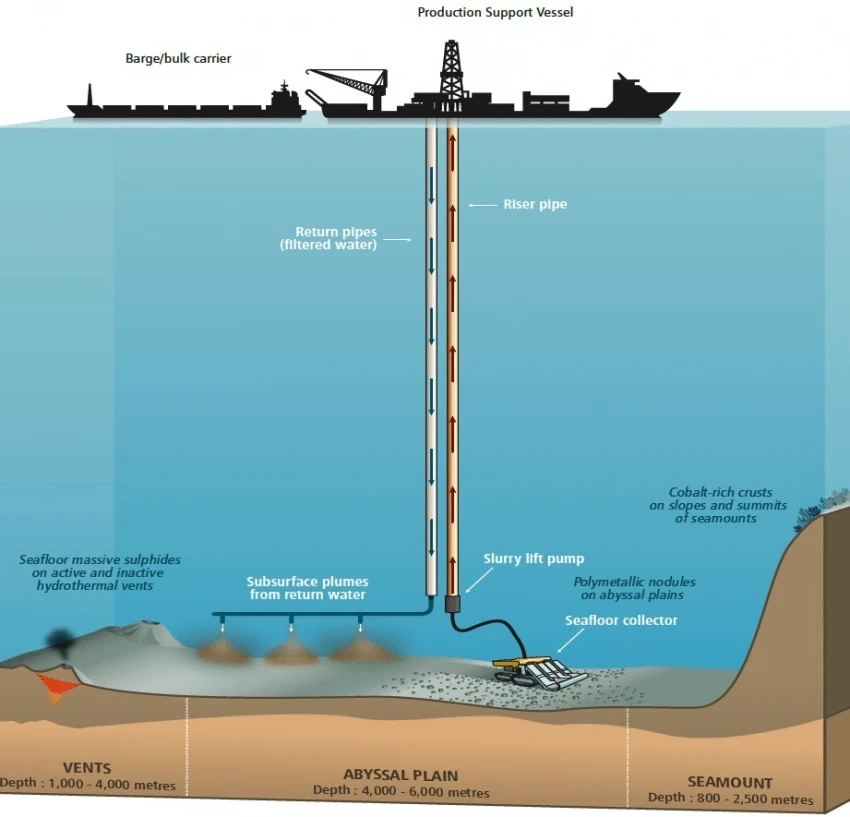
In extreme applications such as deep-sea equipment (6000 m depth ≈ 60 MPa), high-pressure test rigs (10,000 PSI ≈ 69 MPa), and hydraulic bolt tensioners (150 MPa+), hydraulic cylinders now operate far beyond traditional industrial standards (25–35 MPa).
High pressure doesn’t just increase thrust — it multiplies safety risks exponentially:
- Insufficient wall thickness → cylinder barrel bursting → equipment damage + personal injury
- Safety factor too low → fatigue failure → sudden leakage + unplanned downtime
- Over-engineering → weight increase of 50%+ → reduced equipment efficiency + higher cost
So how do you scientifically calculate hydraulic cylinder wall thickness? Should the safety factor be 2, 3, or 4? How do you select the optimal solution for different materials and operating conditions?
Drawing on 10 years of high-pressure hydraulic cylinder design experience and 500+ project cases, this guide reveals the engineering calculation logic behind safe high-pressure cylinder design.
1. Definition and Industry Applications of High-Pressure Hydraulic Cylinders
1.1 Pressure Classification
| Pressure Grade | Working Pressure Range | Typical Applications |
|---|---|---|
| Low Pressure | 0–16 MPa (0–2320 PSI) | Agricultural machinery, general industrial equipment |
| Medium Pressure | 16–25 MPa (2320–3625 PSI) | Construction machinery, injection molding machines |
| High Pressure | 25–42 MPa (3625–6090 PSI) | Metallurgical equipment, marine hydraulics |
| Ultra-High Pressure | 42–70 MPa (6090–10150 PSI) | Deep-sea equipment, test rigs |
| Extreme Pressure | 70–150 MPa (10150–21750 PSI) | Hydraulic tensioners, waterjet cutting |
| Super Extreme Pressure | >150 MPa (>21750 PSI) | Specialized research equipment |
This guide focuses on: High-pressure cylinders above 5000 PSI (34.5 MPa)
1.2 Typical Application Scenarios
| Industry | Application | Working Pressure | Special Requirements |
|---|---|---|---|
| Marine Engineering | Deep-sea ROV, subsea Christmas trees | 40–70 MPa | Seawater corrosion resistance, external pressure resistance |
| Energy & Power | Steam turbine bolt tensioners | 80–150 MPa | Ultra-high pressure, short stroke |
| Industrial Testing | Hydraulic component test rigs | 50–100 MPa | Frequent pressure cycling |
| Mining Machinery | Hydraulic supports, crushers | 35–50 MPa | Impact loads, dusty environment |
| Aerospace | Landing gear, actuators | 35–50 MPa | Lightweight, high reliability |
| Special Equipment | Hydraulic jacks, lifting devices | 50–80 MPa | High tonnage, safety-critical |
2. Failure Modes and Risk Analysis of High-Pressure Cylinders
2.1 Primary Failure Modes
| Failure Type | Failure Mechanism | Typical Symptoms | Risk Level |
|---|---|---|---|
| Barrel Burst | Hoop stress exceeds material ultimate strength | Sudden rupture, oil spray | 🔴 Extreme |
| Plastic Deformation | Stress exceeds yield strength | Permanent barrel expansion, seal failure | 🔴 High |
| Fatigue Cracking | Cyclic stress causes crack propagation | Progressive leakage, eventual fracture | 🟠 High |
| Buckling Instability | Piston rod slenderness ratio too large | Rod bending, jamming | 🟠 High |
| Thread Failure | End cap thread shear/tensile failure | End cap ejection, leakage | 🔴 Extreme |
| Seal Extrusion | High-pressure forces seal material into gaps | Internal/external leakage, seal damage | 🟡 Medium |
2.2 Risk Quantification
Failure consequence severity assessment:
| Consequence Type | Economic Loss | Safety Risk | Reputational Impact |
|---|---|---|---|
| Minor leakage | <¥10,000 | None | Minor |
| Serious leakage | ¥10,000–100,000 | Low | Moderate |
| Component damage | ¥100,000–500,000 | Medium | Significant |
| Equipment loss | ¥500,000–5,000,000 | High | Severe |
| Personal injury | >¥5,000,000 | Extreme | Catastrophic |
Design Principle: For applications involving personal safety, safety factors must be set at the upper limit, and 100% pressure testing is mandatory.
3. Six Core Hydraulic Cylinder Wall Thickness Calculation Formulas and Technical Notes
Formula 1: Thin-Wall Cylinder Formula (Applicable when D/t ≥ 20)
Applicable conditions: Cylinder outer diameter / wall thickness ≥ 20; suitable for low-to-medium pressure
t = (P × D) / (2 × σ_allowable × η + P) + C
| Variable | Description |
|---|---|
| t | Minimum wall thickness (mm) |
| P | Design pressure (MPa) |
| D | Cylinder bore diameter (mm) |
| σ_allowable | Allowable material stress (MPa) |
| η | Weld joint efficiency (seamless tube η=1; welded tube η=0.8–0.9) |
| C | Corrosion allowance (mm), typically 1–3 mm |
Allowable stress calculation:
σ_allowable = σ_yield / n
- σ_yield: Material yield strength (MPa)
- n: Safety factor (typically 2–4)
Example calculation:
- Bore diameter D = 100 mm
- Design pressure P = 35 MPa
- Material: 27SiMn, σ_yield = 520 MPa
- Safety factor n = 3
- Corrosion allowance C = 2 mm
σ_allowable = 520 / 3 = 173 MPa
t = (35 × 100) / (2 × 173 × 1 + 35) + 2
t = 3500 / 381 + 2 = 9.2 + 2 = 11.2 mm
→ Round up: t = 12 mm
Formula 2: Thick-Wall Cylinder Formula (Applicable when D/t < 20)
Applicable conditions: High-pressure / ultra-high-pressure applications — the thick-wall formula is mandatory.
t = D/2 × [√((σ_allowable + P) / (σ_allowable - P)) - 1]
| Variable | Description |
|---|---|
| t | Minimum wall thickness (mm) |
| D | Cylinder bore diameter (mm) |
| P | Design pressure (MPa) |
| σ_allowable | Allowable material stress (MPa) |
Example calculation (ultra-high pressure):
- Design pressure P = 70 MPa
- Other parameters unchanged from Formula 1
σ_allowable = 520 / 3 = 173 MPa
t = 100/2 × [√((173 + 70) / (173 - 70)) - 1]
t = 50 × [√(243 / 103) - 1]
t = 50 × [√2.36 - 1] = 50 × [1.54 - 1] = 50 × 0.54 = 27 mm
Verification: D/t = 100/27 = 3.7 < 20 → Confirmed thick-wall; formula is applicable ✓
Formula 3: Maximum Working Stress Verification
Purpose: Verify that the maximum hoop stress at the inner wall is within safe limits.
σ_hoop_max = P × (D_o² + D_i²) / (D_o² - D_i²)
| Variable | Description |
|---|---|
| σ_hoop_max | Maximum hoop stress at inner wall (MPa) |
| P | Working pressure (MPa) |
| D_o | Cylinder outer diameter (mm) |
| D_i | Cylinder bore diameter (mm) |
Safety condition: σhoop_max ≤ σyield / n
Example verification:
- D_i = 100 mm, t = 27 mm, D_o = 154 mm
- P = 70 MPa, σ_yield = 520 MPa, n = 3
σ_hoop_max = 70 × (154² + 100²) / (154² - 100²)
= 70 × (23716 + 10000) / (23716 - 10000)
= 70 × 33716 / 13716 = 70 × 2.46 = 172 MPa
Allowable stress = 520 / 3 = 173 MPa
172 MPa < 173 MPa ✓ Safe
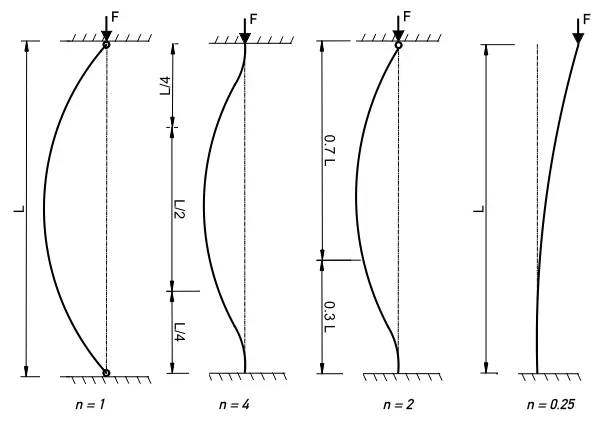
Formula 4: Piston Rod Diameter and Buckling Verification
Purpose: Prevent the piston rod from buckling under compressive load.
F_critical = (π² × E × I) / (K × L)²
| Variable | Description |
|---|---|
| F_critical | Critical buckling load (N) |
| E | Elastic modulus (MPa); steel ≈ 2.1×10⁵ MPa |
| I | Area moment of inertia (mm⁴); I = π×d⁴/64 |
| K | End condition factor (pin-pin K=1; fixed-free K=2) |
| L | Effective rod length (mm) |
Safety condition:
F_working × n_buckling ≤ F_critical
- n_buckling: Buckling safety factor, typically 3–4
Piston rod diameter estimation:
d ≥ 0.03 × √F_working (F in N, d in mm)
Or by rule of thumb: d ≈ (0.5–0.7) × D_cylinder
Formula 5: End Cap Thread Strength Verification
Purpose: Ensure end cap threads do not fail in shear or tension under high pressure.
Thread shear strength:
τ = F / (π × d_pitch × h × z)
| Variable | Description |
|---|---|
| τ | Thread shear stress (MPa) |
| F | Axial load (N); F = P × π × D_i² / 4 |
| d_pitch | Thread pitch diameter (mm) |
| h | Thread tooth height (mm) |
| z | Number of engaged threads |
Safety condition: τ ≤ τallowable (typically σyield / 4)
Thread tensile strength:
σ_tensile = F / A_stress
- A_stress: Thread stress area (mm²)
- Safety condition: σtensile ≤ σyield / n
Design recommendations:
- For high-pressure cylinder end caps, prefer flange + tie-rod connections
- If threads are required, minimum engaged threads z ≥ 8–10
- Use fine threads (lower stress concentration)
Formula 6: Fatigue Life Estimation
Purpose: Predict fatigue life under pressure cycling.
S-N Curve Simplified Estimation:
N = (σ_a / σ_f')^(-1/b)
| Variable | Description |
|---|---|
| N | Fatigue life (number of cycles) |
| σ_a | Stress amplitude (MPa) |
| σ_f’ | Fatigue strength coefficient (material constant) |
| b | Fatigue strength exponent (material constant; ≈ −0.09 for steel) |
Simplified engineering guide for carbon/alloy steel:
| Stress Level | Expected Fatigue Life |
|---|---|
| < 50% σ_yield | > 1,000,000 cycles |
| 50–70% σ_yield | 100,000–1,000,000 cycles |
| 70–85% σ_yield | 10,000–100,000 cycles |
| > 85% σ_yield | Not recommended for cyclic duty |
Recommendation: Keep working stress below 60% σ_yield to ensure a fatigue life exceeding 500,000 cycles.
4. Safety Factor Selection Logic and Industry Standards
4.1 Factors Affecting Safety Factor
| Factor | Impact | Safety Factor Adjustment |
|---|---|---|
| Load type | Static vs. dynamic vs. impact | Dynamic +0.5; Impact +1.0 |
| Material reliability | Certified vs. standard material | Standard material +0.5–1.0 |
| Manufacturing process | Forged vs. welded vs. cast | Welded +0.5; Cast +1.0 |
| Operating environment | Normal vs. high/low temp / corrosion | Harsh environment +0.5–1.0 |
| Failure consequence | Economic loss vs. personal safety risk | Personal safety +1.0–2.0 |
| Inspection level | 100% inspection vs. sampling | Sampling +0.5 |
4.2 Industry Standard Recommended Values
| Standard / Code | Application | Minimum Safety Factor |
|---|---|---|
| GB/T 15622 (China Hydraulic Cylinder Standard) | General industrial | 2.5–3.0 |
| ISO 6020/6022 (International Standard) | Industrial hydraulics | 2.5–3.5 |
| ASME BPVC (Boiler and Pressure Vessel Code) | Pressure vessels | 3.0–4.0 |
| DNV-GL (Marine Engineering) | Offshore/deep-sea | 3.5–4.5 |
| API 6A (Oil & Gas) | Wellhead equipment | 4.0–5.0 |
| Aerospace | Aircraft systems | 4.0–6.0 |
4.3 Recommended Values
| Application | Working Pressure | Recommended Safety Factor | Verification Requirement |
|---|---|---|---|
| General industrial | < 35 MPa | 2.5–3.0 | 1.5× pressure test |
| Construction machinery | 35–50 MPa | 3.0–3.5 | 2.0× pressure test |
| Marine engineering | 40–70 MPa | 3.5–4.0 | 2.5× pressure test + fatigue verification |
| Test equipment | 50–100 MPa | 4.0–4.5 | 3.0× pressure test + 100% NDT |
| Personal safety-critical | Any pressure | ≥ 4.5 | 3.0× pressure test + third-party certification |
5. Industry Case Studies
Case 1: 6000 m Deep-Sea ROV Hydraulic Cylinder
Client: A marine engineering equipment manufacturer
Challenge: Operating depth 6000 m (external pressure 60 MPa), internal pressure 50 MPa, bidirectional high pressure, seawater corrosion environment.
Solution:
Wall thickness calculation:
- Bore diameter D_i = 80 mm
- Design pressure P = 50 MPa (internal) + 60 MPa (external) = 100 MPa equivalent
- Material: 17-4PH stainless steel (seawater corrosion resistant), σ_yield = 720 MPa
- Safety factor n = 4.0 (marine + deep-sea)
σ_allowable = 720 / 4 = 180 MPa
t = 80/2 × [√((180 + 100) / (180 - 100)) - 1]
t = 40 × [√(280/80) - 1] = 40 × [√3.5 - 1] = 40 × 0.87 = 34.8 mm
→ Round up: t = 36 mm, D_o = 152 mm
Verification testing:
- Static pressure test: 250 MPa (2.5×) × 3 minutes — no leakage, no deformation
- Fatigue test: 50 MPa × 500,000 cycles — no cracking
- Salt spray test: 1000 hours neutral salt spray — corrosion grade ≤ Level 2
Result: DNV-GL certified; deployed successfully for 3 years with zero failures.
Case 2: 10,000 PSI Hydraulic Test Rig Cylinder
Client: A hydraulic component testing center
Challenge: Test pressure 70 MPa (10,000 PSI), high-frequency pressure cycling (10 cycles/minute), 24-hour continuous operation.
Solution:
Fatigue-optimized design:
- Cylinder material: 42CrMo quenched and tempered, σ_yield = 680 MPa
- Safety factor n = 4.5 (high-frequency cycling + test equipment)
- Inner wall roller burnishing (improves fatigue strength by 20–30%)
- Transition radii R ≥ 3 mm (reduces stress concentration)
Wall thickness calculation:
D_i = 60 mm, P = 70 MPa, σ_allowable = 680/4.5 = 151 MPa
t = 60/2 × [√((151 + 70) / (151 - 70)) - 1]
t = 30 × [√(221/81) - 1] = 30 × [√2.73 - 1] = 30 × 0.65 = 19.5 mm
→ Round up: t = 22 mm (fatigue margin applied)
Verification testing:
- Pressure cycling: 70 MPa × 2,000,000 cycles — no leakage
- Burst test: failure at 210 MPa (3.0×); fracture analysis confirms ductile fracture mode
Result: Operated continuously for 2 years, completing over 5,000,000 pressure cycles with stable performance.
Case 3: 150 MPa Hydraulic Bolt Tensioner Cylinder
Client: A power equipment manufacturer
Challenge: Working pressure 150 MPa, short stroke (50 mm), extremely compact structure required, safety factor ≥ 5.
Solution:
Extreme-pressure design:
- Cylinder material: 300M ultra-high-strength steel, σ_yield = 1450 MPa
- Safety factor n = 5.0 (extreme pressure + personal safety)
- Construction: monolithic forging, no welds
Wall thickness calculation:
D_i = 40 mm, P = 150 MPa, σ_allowable = 1450/5 = 290 MPa
t = 40/2 × [√((290 + 150) / (290 - 150)) - 1]
t = 20 × [√(440/140) - 1] = 20 × [√3.14 - 1] = 20 × 0.77 = 15.4 mm
→ Round up: t = 18 mm, D_o = 76 mm
Special design features:
- End cap uses conical face seal + thread lock
- Piston rod surface hard chrome plated (hardness ≥ HRC 60)
- 100% ultrasonic inspection + magnetic particle inspection
Result: Passed third-party pressure vessel certification; successfully deployed in 30+ power plant maintenance projects.
6. Frequently Asked Questions (FAQ)
Q1: Is the thick-wall formula always required for high-pressure cylinders?
The thick-wall formula (Lamé’s Equation) is mandatory when D/t < 20. The thin-wall formula underestimates stress and creates safety hazards. General rule of thumb:
- Pressure < 25 MPa: Thin-wall formula acceptable
- Pressure 25–40 MPa: Thick-wall verification recommended
- Pressure > 40 MPa: Thick-wall formula mandatory
Q2: What is the practical difference between a safety factor of 3 vs. 4?
Using a 70 MPa cylinder (σ_yield = 520 MPa) as an example:
- n = 3: Allowable stress 173 MPa, wall thickness ≈ 27 mm
- n = 4: Allowable stress 130 MPa, wall thickness ≈ 38 mm
Wall thickness increases by 40%, weight by approximately 35%, cost by 25–30% — but fatigue life improves by a factor of 3–5. For critical applications, the higher value is recommended.
Q3: Are imported materials safer than domestic materials?
The key is material certification, not country of origin:
- Imported brands (materials specified by Parker, Rexroth): Full mill certificates + third-party test reports
- Certified domestic materials (major mills such as Baowu, Xingcheng): Equivalent standards, 30–40% lower cost
We use certified domestic materials with 100% incoming inspection, benchmarked against import specifications.
Q4: How often should high-pressure cylinders be pressure-tested?
Depends on application:
- General industrial: Every 2 years or every 5,000 operating hours
- Critical equipment (lifting, personal safety): Annually or every 2,000 operating hours
- Marine / corrosive environments: Annually + after every major overhaul
- Test equipment: Every 6 months
Q5: Can you provide a wall thickness calculation report as an acceptance document?
Yes. All high-pressure cylinder projects include:
- Wall thickness calculation report (formulas, parameters, results)
- Stress analysis report (CAE simulation)
- Pressure test report (measured data)
- Material certificate (original mill quality certificate)
7. Conclusion
The safety of a high-pressure cylinder is not achieved by “adding more thickness” — it is achieved through scientific calculation, proper material selection, and rigorous verification:
- Wall thickness calculation must use the correct formula (thick-wall vs. thin-wall)
- Safety factor must account for operating conditions, materials, and failure consequences
- Fatigue life must be predicted and verified at the design stage
- Pressure testing is the final line of defense and must never be skipped
Choosing a supplier with solid calculation capability, simulation capability, and verification capability is the key to ensuring that high-pressure cylinders are safe and reliable.
8. Why Choose Our High-Pressure Cylinder Services?
- Expert engineering team — 5 hydraulic design engineers, proficient in high-pressure cylinder calculation and simulation
- Complete documentation — Every project includes a detailed wall thickness calculation report + stress analysis report
- In-house pressure test rig — 200 MPa test capability for 1.5× to 3.0× verification
- Certified materials — Partnership with major mills; full material traceability
- Industry experience — 100+ high-pressure projects across marine engineering, power, and test equipment
- Quality certifications — ISO 9001, CE, DNV-GL certified; exported to 30+ countries
9. Request a Calculation Report and Pressure Verification Report
Our engineers will provide the following free of charge:
- Preliminary wall thickness calculation (based on your operating parameters)
- Safety factor selection recommendations
- Material recommendations (with cost comparison)
- Pressure testing plan recommendations
Information required:
- Working pressure (MPa / PSI)
- Cylinder bore diameter (mm)
- Stroke (mm)
- Operating environment (temperature, fluid medium, corrosion conditions, etc.)
- Required safety level
Appendix: Common Material Mechanical Properties
| Material | Yield Strength σ_yield (MPa) | Tensile Strength σ_ut (MPa) | Elongation δ (%) | Applicable Pressure |
|---|---|---|---|---|
| 20# Steel | 245 | 410 | 25 | < 25 MPa |
| 45# Steel | 355 | 600 | 16 | < 35 MPa |
| 27SiMn | 520 | 685 | 15 | < 50 MPa |
| 42CrMo | 680 | 850 | 12 | < 70 MPa |
| 30CrMo | 585 | 735 | 14 | < 60 MPa |
| 17-4PH | 720 | 930 | 15 | < 80 MPa (corrosion resistant) |
| 300M | 1450 | 1620 | 8 | < 150 MPa (ultra-high strength) |