In marine and offshore operations, corrosion resistant hydraulic cylinders are the difference between decades of reliable service and premature failure. Standard cylinders that perform well onshore can fail within months when deployed offshore.
Problem: Why do standard hydraulic cylinders fail so rapidly in saltwater environments? And what technologies actually deliver the corrosion resistance needed for 20+ year service lives offshore?
Answer: Saltwater creates electrochemical attack that penetrates standard coatings and destroys base materials through mechanisms standard industrial designs cannot resist. Corrosion resistant hydraulic cylinders require multi-layered protection: the right base material, advanced coating technology, engineered sealing systems, and cathodic protection working together. This guide examines the science of marine corrosion, evaluates competing protection technologies, and provides practical specifications for long-term offshore reliability.
- Understanding Marine Corrosion Mechanisms
- Material Selection for Corrosion Resistance
- Advanced Coating Technologies for Corrosion Protection
- Sealing System Engineering for Corrosion Prevention
- Comparative Performance: Corrosion Protection Technologies
- Case Studies: Corrosion Resistant Hydraulic Cylinders in Offshore Service
- Frequently Asked Questions (FAQ)
- Conclusion
- Why Choose Cenbifyn for Corrosion Resistant Hydraulic Cylinders?
Offshore environments are arguably the most challenging conditions for hydraulic equipment on Earth. Saltwater immersion or spray, high humidity, temperature cycling, UV exposure, and H₂S or CO₂ contamination combine to create a perfect storm for corrosion.
Making the right decisions for corrosion resistant hydraulic cylinders requires understanding electrochemistry, material science, and coating technology — knowledge that goes well beyond standard hydraulic engineering. This guide provides what you need to protect offshore investments over equipment lifetimes that span decades.
Understanding Marine Corrosion Mechanisms
1. Electrochemical Corrosion Fundamentals
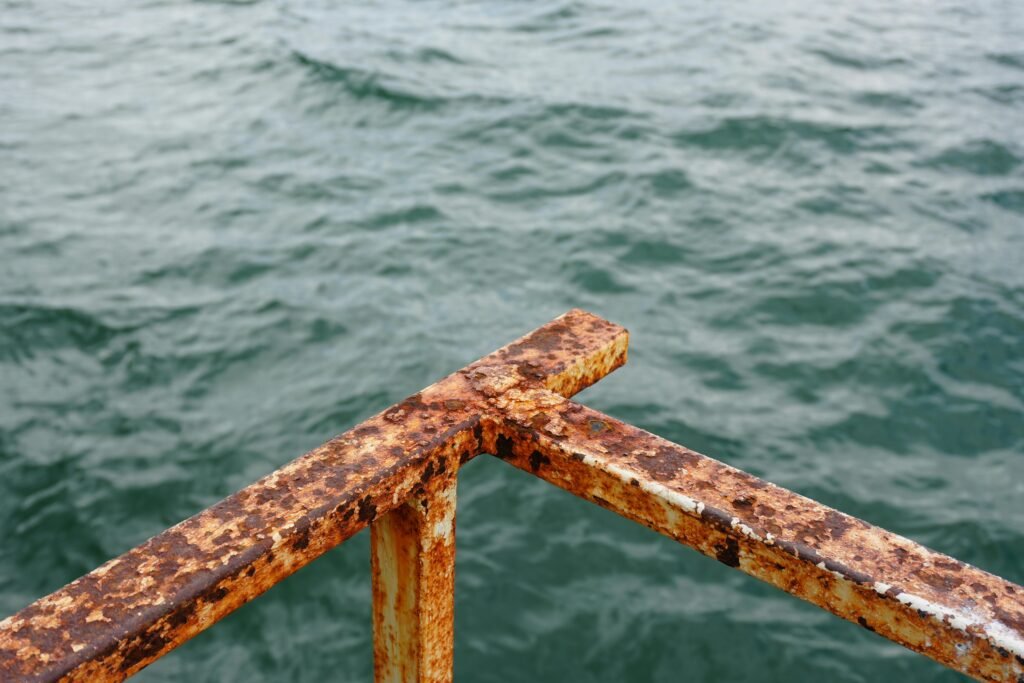
Saltwater is an ideal electrolyte for electrochemical corrosion. This is why corrosion resistant hydraulic cylinders require specialized engineering for marine applications.
The Corrosion Process: When dissimilar metals contact each other in saltwater, a galvanic cell forms. The less noble metal becomes the anode and corrodes. The more noble metal becomes the cathode and remains protected. In hydraulic cylinders, this happens at interfaces between steel components, chrome plating, seal materials, and mounting hardware.
Pitting Corrosion: Pitting is the most dangerous form of attack on cylinder rods. Chloride ions penetrate microscopic defects in the plating, creating localized galvanic cells that eat into the base material. Once pitting starts, it accelerates rapidly. A single pit just 0.005″ deep can destroy a rod seal in as little as 100 operating cycles.
Crevice Corrosion: This type forms in narrow gaps — between the piston rod and wiper seal, or between the cylinder tube and end caps. Limited oxygen access in these crevices creates localized corrosion cells that progress undetected until structural failure occurs.
Stress Corrosion Cracking (SCC): Under tensile stress in corrosive environments, even ductile materials can develop cracks. In H₂S environments, this takes the form of sulfide stress cracking (SSC) — a significant safety hazard for corrosion resistant hydraulic cylinders in sour service.
2. Environmental Factors Accelerating Corrosion
Several offshore conditions combine to make corrosion protection especially challenging for corrosion resistant hydraulic cylinders.
Salt Concentration: Seawater contains about 3.5% dissolved salts, primarily sodium chloride. This creates a highly conductive electrolyte that accelerates corrosion rates 10-100 times faster than freshwater.
Temperature Effects: Corrosion rates roughly double with every 18°F (10°C) temperature increase. In tropical offshore environments with water temperatures reaching 85-95°F, corrosion proceeds significantly faster than in cold northern waters. Temperature cycling also creates thermal stress that cracks and delaminates coatings.
Biofouling: Marine organisms attach to cylinder surfaces and create oxygen concentration cells beneath their colonies. These cells accelerate localized corrosion. Biofilms also produce acidic byproducts that attack both metal surfaces and protective coatings.
Hydrogen Sulfide (H₂S) and CO₂: Sour service environments add further corrosion mechanisms. H₂S causes hydrogen embrittlement and sulfide stress cracking. CO₂ forms carbonic acid that accelerates general corrosion. Both conditions require corrosion resistant hydraulic cylinders with specialized materials and sealing.
Mechanical Factors: Wave-induced vibration, equipment movement, and operational cycling create fretting corrosion at contact points. Repeated flexing cracks protective coatings and exposes fresh base metal. Impact damage from dropped tools or swinging equipment creates immediate corrosion initiation points.
Material Selection for Corrosion Resistance
The base material is the foundation of any reliable corrosion resistant hydraulic cylinder.
1. Stainless Steel Alloys
316/316L Stainless Steel: This is the most common material for moderately corrosive offshore applications. The 2-3% molybdenum content provides significantly better chloride resistance than 304 stainless. The low-carbon 316L grade prevents sensitization during welding and reduces intergranular corrosion risk. Typical applications include deck machinery, valve actuators, and cranes operating above the splash zone.
Duplex and Super Duplex Stainless Steels: These alloys combine austenitic and ferritic microstructures, delivering roughly twice the strength of 316 stainless with superior corrosion resistance. 22% Cr duplex achieves a PREN (Pitting Resistance Equivalent Number) of 35-40. 25% Cr super duplex exceeds PREN 40. These grades are the current standard for corrosion resistant hydraulic cylinders in subsea and splash zone applications.
High-Performance Alloys: For the most severe conditions — including deep sour service — nickel-based alloys such as Alloy 825, Alloy 625, and Alloy C-276 provide exceptional corrosion resistance. They resist H₂S-induced cracking, chloride pitting, and crevice corrosion. The cost premium is significant at 5-10x the price of 316 stainless, but justified in critical applications.
2. Carbon Steel with Advanced Protection
Carbon steel with advanced coatings remains the most common approach for corrosion resistant hydraulic cylinders due to cost. Stainless steel offers inherent corrosion resistance, but carbon steel is substantially less expensive — provided the coating system is properly specified and applied.
Material Grades: High-strength carbon steels such as 4130, 4140, and 4340 provide the mechanical properties needed for high-pressure operation. Any defect in the coating system, however, will lead to rapid corrosion. Complete and continuous surface protection is non-negotiable.
Weldability Considerations: Carbon steel cylinders require post-weld heat treatment to relieve residual stresses that could cause stress corrosion cracking. Weld procedure qualification per AWS D1.1 is essential, with NDE including magnetic particle inspection and ultrasonic testing.
Hydrogen Embrittlement Prevention: High-strength carbon steels are susceptible to hydrogen embrittlement during electroplating. Baking at 375°F for a minimum of 24 hours removes absorbed hydrogen and prevents delayed cracking after plating.
Advanced Coating Technologies for Corrosion Protection
Coating technology has advanced significantly. Modern corrosion resistant hydraulic cylinders benefit from options that far outperform the traditional hard chrome standard.
1. Traditional Plating Technologies and Their Limitations
Hard Chrome Plating: Hard chrome has been the standard for hydraulic cylinder rods for decades. It provides hardness of 65-72 HRC with moderate corrosion resistance. However, its limitations are well documented: porosity allows chloride penetration, micro-cracking develops under thermal stress, hexavalent chromium raises environmental concerns, and salt spray resistance is only 40-100 hours. For onshore industrial use, these limitations are often acceptable. For offshore service, they are not.
Electroless Nickel Plating: Electroless nickel provides uniform coverage on complex geometries and better corrosion resistance than hard chrome. PTFE-impregnated versions add low friction properties. Hardness is lower at 45-55 HRC, and salt spray resistance typically ranges from 350-500 hours — better than chrome, but still insufficient for long-term offshore service.
Nickel-Chrome Dual Plating: An underlying nickel layer combined with hard chrome improves salt spray resistance to approximately 500 hours. This represents a step forward, but still falls short of what offshore environments demand.
2. Modern High-Performance Coating Solutions
Laser Cladding (Eatonite and Similar Technologies): Laser cladding is the current state-of-the-art for corrosion resistant hydraulic cylinders. A laser melts powdered alloy — typically cobalt-based or nickel-based — onto the substrate, creating a metallurgically bonded coating with zero porosity.
Key performance data: salt spray resistance exceeds 2,000 hours (ASTM B117), bond strength exceeds 40 MPa (5,800 PSI), and surface hardness reaches 55-62 HRC. The coating is also field-repairable using conventional fusion welding, and DNV certified for offshore applications. Field experience confirms Eatonite-coated rods operating offshore for over 12 years without measurable corrosion or performance loss.
High-Velocity Oxygen Fuel (HVOF) Thermal Spray Coatings: Tungsten carbide-cobalt (WC-Co) and ceramic coatings applied at supersonic velocities create dense, well-bonded coatings with excellent wear and corrosion resistance. Salt spray resistance reaches 500-1,000+ hours, and tungsten carbide hardness reaches 70-75 HRC. Application cost is lower than laser cladding. Limitations include potential porosity that requires post-sealing, and lower bond strength compared to laser cladding.
Ceramic Coatings: Advanced ceramic coatings such as Ceracote achieve 1,000-2,000 hours of salt spray resistance with hardness of 800-900 HV. They represent an excellent option for corrosion resistant hydraulic cylinders in splash zone and moderate offshore service.
3. External Paint and Coating Systems
The external surfaces of corrosion resistant hydraulic cylinders — tube bodies and end caps — require specialized marine-grade paint systems.
Multi-Coat System Specification: Surface preparation starts with near-white metal blast (SSPC-SP 10/NACE No. 2) to create a 2.5-4.0 mil anchor profile. A zinc-rich primer at 3.0-4.0 mils provides galvanic protection. A high-build epoxy intermediate coat at 8.0-12.0 mils builds the corrosion barrier. A polyurethane topcoat at 2.0-3.0 mils adds UV resistance and aesthetics.
Total DFT (Dry Film Thickness): The minimum total DFT is 13-19 mils for atmospheric exposure and 20-30 mils for immersion service. Application must follow SSPC-PA 2 and NACE standards — improper application undermines even the best coating specification.
Sealing System Engineering for Corrosion Prevention
The rod sealing system is both the most critical barrier against corrosion ingress and the component most vulnerable to corrosion damage in corrosion resistant hydraulic cylinders.
1. Multi-Stage Sealing Architecture
Effective offshore sealing requires progressive protection stages that work together to block saltwater ingress.
Stage 1: Metallic Scraper A hardened metallic scraper is the first line of defense. During rod retraction, it removes heavy contamination, salt crystals, and marine growth from the rod surface. This prevents large abrasive particles from reaching the wiper and primary seals.
Stage 2: Double-Lip Polyurethane Wiper The double-lip polyurethane wiper is the primary contamination exclusion seal. It prevents water, salt spray, and particulate from entering the cylinder gland. Corrosion resistant hydraulic cylinders for offshore use typically specify 95 Shore A polyurethane formulated for hydrolysis resistance in marine environments.
Stage 3: Buffer Seal The buffer seal absorbs pressure spikes and provides secondary sealing protection. It also acts as a fluid barrier, stopping any moisture that penetrates the wiper from reaching the hydraulic fluid.
Stage 4: Primary Rod Seal The primary rod seal — typically a U-cup or step seal in FKM or HNBR — maintains system pressure and prevents internal leakage between the hydraulic fluid and the environment.
Stage 5: Static Seals FKM O-rings with corrosion inhibitors provide long-term sealing at all static joints, including end caps, ports, and gland connections.
2. Material Compatibility Considerations
Seal materials must resist both external saltwater and chemical attack from hydraulic fluids and wellstream contaminants.
FKM (Viton®) provides excellent high-temperature resistance and compatibility with petroleum fluids, saltwater, and H₂S. Temperature range: -20°F to +400°F.
HNBR offers superior mechanical properties and resistance to sour gas and amine-based corrosion inhibitors. Temperature range: -40°F to +300°F.
PTFE compounds provide excellent chemical resistance and low friction. They are commonly used in piston seals and wear rings, often energized with O-rings to maintain sealing force.
FFKM delivers near-universal chemical resistance and is specified for extreme H₂S concentrations or specialty production chemicals. It carries a significant cost premium but provides unmatched protection in the most aggressive environments.
3. Cathodic Protection Integration
For corrosion resistant hydraulic cylinders in permanent immersion service, external cathodic protection is essential — coating systems alone are not sufficient.
Sacrificial Anode Systems: Zinc or aluminum-zinc-indium alloy anodes attach directly to the cylinder. The anode material corrodes preferentially, protecting the cylinder base metal from electrochemical attack.
Design Considerations: Proper anode design requires calculating total surface area requiring protection, determining required current density (typically 10-20 mA/m² for seawater), sizing anodes for 15-20 year design life, ensuring electrical continuity throughout all cylinder components, and providing adequate spacing to prevent shielding effects between anodes.
Impressed Current Cathodic Protection (ICCP): For large subsea installations, ICCP systems use an external power supply to deliver controlled protection. This allows engineers to monitor and adjust protection levels throughout the equipment’s service life.
Comparative Performance: Corrosion Protection Technologies
| Protection Technology | Salt Spray Resistance (ASTM B117) | Typical Cost Multiplier | Wear Resistance | Field Repairability | Best Application |
|---|---|---|---|---|---|
| Standard Hard Chrome | 40-100 hours | 1.0x | Excellent | No | Onshore industrial |
| Electroless Nickel | 350-500 hours | 1.2x | Good | Limited | Mild marine |
| HVOF Tungsten Carbide | 500-1,000 hours | 1.8x | Excellent | Limited | Moderate offshore |
| Laser Cladding (Eatonite) | 2,000+ hours | 2.5x | Very Good | Yes | Critical offshore |
| Ceramic Coating (Ceracote) | 1,000-2,000 hours | 2.2x | Excellent | Limited | Splash zone |
| 316L Stainless Steel | 500-1,000 hours | 2.0x | Fair | Yes | Atmospheric offshore |
| Super Duplex Stainless | 2,000+ hours | 4.0x | Good | Yes | Subsea/sour service |
Laser cladding carries a 2.5x cost premium over standard chrome — but delivers 20-50x better corrosion resistance and a demonstrated 12+ year offshore service life. A single cylinder failure on an offshore platform can cost $100,000+ in vessel mobilization and lost production. In that context, the premium for properly specified corrosion resistant hydraulic cylinders pays for itself quickly.
Case Studies: Corrosion Resistant Hydraulic Cylinders in Offshore Service
Hypothetical Scenario: North Sea Platform BOP Control System Upgrade
Challenge: A North Sea operator experienced chronic BOP control cylinder failures, with average service life of only 18 months. Standard hard chrome rods developed pitting corrosion that destroyed seals. Painted tube surfaces developed extensive rust. Each cylinder replacement required vessel mobilization at approximately $250,000 plus lost production.
Cenbifyn Solution: We designed corrosion resistant hydraulic cylinders featuring Eatonite laser cladded piston rods (DNV certified), super duplex stainless steel piston and rod end components, and a multi-stage sealing system — metallic scraper, PU double-lip wiper, FKM buffer seal, and HNBR primary seal. External coating used a 3-part marine system at 25 mils DFT. Sacrificial zinc anodes were integrated into cylinder mounting brackets. A complete DNV-GL certification package was included.
Results: After 7 years of continuous North Sea service, the cylinders show zero measurable corrosion and no seal degradation. The operator documented zero unplanned cylinder replacements, avoiding an estimated $8.75 million in vessel mobilization costs and production losses. This design is now standardized across the operator’s entire North Sea fleet.
Hypothetical Scenario: Gulf of Mexico Offshore Crane Modernization
Challenge: A crane manufacturer needed to upgrade cylinder specifications for their 100-ton offshore pedestal cranes in the Gulf of Mexico. The previous hard chrome specification was failing within 3 years due to splash zone corrosion.
Cenbifyn Solution: We developed corrosion resistant hydraulic cylinders with HVOF tungsten carbide rod coatings with post-sealing treatment, 316L stainless steel external hardware and fasteners, polyurethane seals formulated for hydrolysis resistance, and an enhanced gland drainage system to prevent water accumulation. Cylinders were qualified to 1,000-hour salt spray testing and certified to API 2C for offshore lifting equipment.
Results: After 5 years in service, the cranes recorded zero corrosion-related failures. The manufacturer extended their warranty from 1 year to 3 years — a significant competitive advantage in the offshore crane market.
Hypothetical Scenario: Subsea Tree Actuation Cylinder Specification
Situation: A deepwater development project required hydraulic cylinders for subsea tree valve actuation at 6,500 feet water depth. The application demands a 25-year service life with no intervention possible.
Critical Design Requirements: All wetted components require 25% Cr super duplex stainless steel. Working pressure is 15,000 PSI with a 4:1 safety factor. Sealing uses a dual barrier system with FFKM primary seals. Cathodic protection uses integrated aluminum alloy sacrificial anodes sized for 25 years. Testing includes hyperbaric pressure testing and sour service qualification per NACE MR0175/ISO 15156. Documentation requires full DNV-GL type approval with material traceability back to melt.
Key Selection Principle: When intervention is impossible or prohibitively expensive, corrosion resistant hydraulic cylinders should be specified with a minimum 0.125″ corrosion allowance. Material selection should be based on the most severe expected conditions — not the nominal operating environment.
Frequently Asked Questions (FAQ)
Q1: How long should corrosion resistant hydraulic cylinders last in offshore service? A1: With proper specification and maintenance, corrosion resistant hydraulic cylinders with laser cladding or super duplex construction should achieve 15-25 year service lives in atmospheric or splash zone service. Subsea applications target 20-30 years, matching typical field production lifetimes. These figures assume correct initial specification, proper installation, and adherence to recommended maintenance practices.
Q2: Can I upgrade existing offshore cylinders with better coatings during overhaul? A2: Yes — but coating upgrades alone are rarely sufficient. Sealing system upgrades and external paint system renewal should accompany any rod coating upgrade to achieve full performance improvement. Always verify coating compatibility with the existing base material before proceeding.
Q3: What testing validates corrosion resistance for hydraulic cylinders? A3: Standard testing includes ASTM B117 neutral salt spray testing, NACE TM0177 sulfide stress cracking testing for sour service, galvanic compatibility testing between dissimilar metals, cyclic corrosion testing combining salt spray, humidity, and temperature cycling, and field exposure testing at representative offshore locations. Third-party certification per DNV-RP-0172 provides additional quality assurance.
Q4: How important is galvanic compatibility when assembling corrosion resistant hydraulic cylinders? A4: Galvanic incompatibility is a major cause of premature failure in offshore cylinders. When dissimilar metals contact each other in saltwater, the less noble material corrodes preferentially — sometimes at alarming rates. Always verify galvanic compatibility using the seawater galvanic series, and use insulating gaskets or sleeves where incompatible materials must interface.
Q5: What maintenance practices extend the life of corrosion resistant hydraulic cylinders offshore? A5: Key practices include regular freshwater washing of rod surfaces to remove salt deposits, periodic coating inspection with prompt touch-up of any damage, seal replacement on a scheduled basis (typically every 5-7 years), hydraulic fluid analysis monitoring for water content and corrosion inhibitor levels, and cathodic protection inspection with anode replacement as required.
Q6: How do I calculate the required coating thickness for corrosion resistant hydraulic cylinders? A6: Thickness requirements depend on service life expectations and corrosion rate. Atmospheric exposure typically requires 0.005-0.010″ coating thickness. Splash zone service needs 0.010-0.020″. Permanent immersion applications require 0.020-0.040″. Always include a corrosion allowance in base material dimensions — typically 0.050-0.125″ for 20+ year service lives.
Q7: What certification standards apply to corrosion resistant hydraulic cylinders for offshore use? A7: Key standards include DNV-GL (DNV-OS-E101 for drilling facilities), API specifications (API 6A for wellhead equipment, API 2C for offshore cranes), NACE standards (MR0175/ISO 15156 for sour service), and ASTM material standards (A479 for stainless steel bars, B117 for corrosion testing). Always verify that manufacturers provide complete documentation supporting compliance with required standards.
Conclusion
Corrosion resistant hydraulic cylinders are a critical investment in offshore and marine applications. The cost of failure far exceeds the incremental cost of proper specification.
Effective corrosion protection demands a holistic approach: the right base material, the right coating technology, a properly engineered sealing system, cathodic protection, and a consistent maintenance program. No single element is sufficient on its own.
Coating technology continues to advance. Laser cladding, HVOF thermal spray, and high-performance alloys improve year on year. But the fundamental principles remain unchanged — understand the corrosion mechanisms, select materials matched to the environment, apply protection systems with rigorous quality control, and maintain the equipment properly.
For offshore operations where equipment must perform for decades in some of the harshest environments on Earth, investing in properly engineered corrosion resistant hydraulic cylinders is not just good engineering practice. It is essential asset protection.
Why Choose Cenbifyn for Corrosion Resistant Hydraulic Cylinders?
Advanced Coating Application Capabilities: We maintain in-house laser cladding, HVOF thermal spray, and electroless nickel plating facilities. This gives us complete quality control over the most critical component of corrosion resistant hydraulic cylinders. All coatings are tested per ASTM and NACE standards before shipment.
Comprehensive Material Selection Expertise: Our material scientists continuously evaluate new alloys and coating technologies. We maintain an extensive database of corrosion performance data across hundreds of environments and provide material compatibility analysis and lifecycle cost comparisons for every project.
Marine-Grade Paint Application: We operate a climate-controlled paint booth certified to SSPC and NACE standards. Every marine paint application is fully documented with DFT readings and adhesion test results.
Third-Party Certification Support: We provide complete documentation packages for DNV-GL, API, NACE, and ATEX certification. Our team works directly with certification bodies to streamline the approval process for offshore projects.
Field Service and Overhaul Capabilities: Our service teams provide on-site inspection, maintenance, and overhaul services worldwide, including offshore locations. We also offer cylinder recertification and coating upgrade services to extend equipment life and protect your investment.